You might have noticed it quite often. You return home after a long walk or exercise with your dog. As soon as you return home, your dog does not curl up in a unique canine pose. Instead, it lies flat on the floor – front legs stretched forward, stomach flat to the ground, and hind legs stretched behind. A pose that perhaps resembles a frog.
Yes, this is called splooting. This iconic pose is called sploot and is found in both cats and dogs. Of course, it looks cute and adorable. But, when your dog does it every time it returns home from an exercise, you tend to be worried. Why do dogs sploot on cold floor? Or is splooting bad for dog hips?
What Exactly Is a “Sploot”?
A “sploot” occurs when a dog lies flat on their belly with their hind legs extended backward, parallel to their spine, rather than tucked under their body.
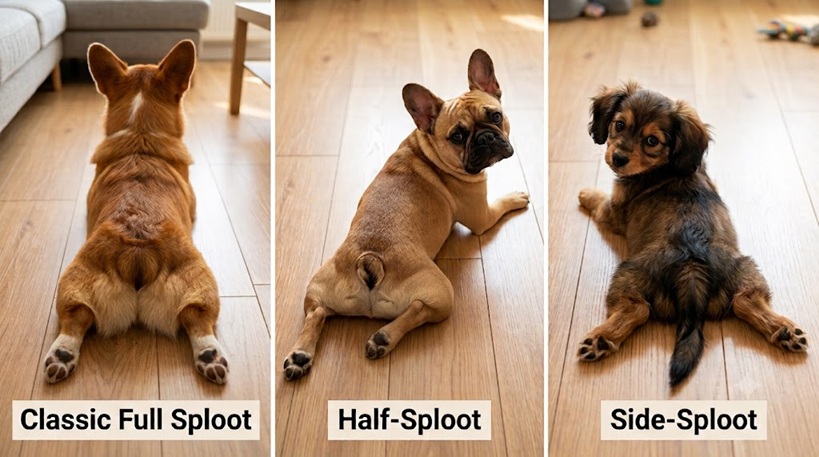
In many cases, you would observe splooting in three variations –
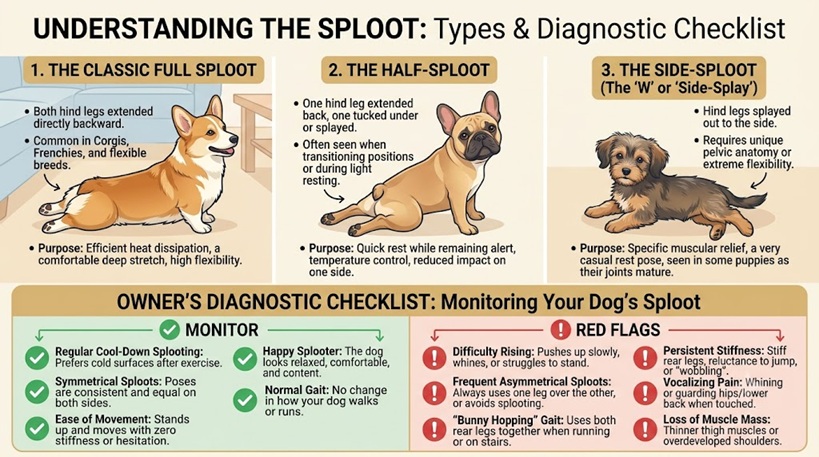
The Classic Full Sploot
Both hind legs extend directly backward behind the torso (the classic “frog dog” pose).
The Half-Sploot
One hind leg extends straight back while the other remains tucked comfortably under the hip.
The Side-Sploot
One or both hind legs stick out sideways from the hips rather than straight back.
Why do Dogs Sploot?
There are multiple reasons that a dog likes to sploot. We will analyse every reason that a dog may like splooting.
Heat regulation and temperature control
Vets and experts call it thermoregulation through conductive cooling. Dogs use the splooting pose to regulate heat.
Dogs do not sweat through their skin as humans do. Their primary heat-release mechanisms are panting (evaporative cooling) and sweat glands located in their paw pads. When internal body temperature rises during exercise, panting alone can take time to bring core temperature down.
Stretching out!
Just like we humans stretch after exercise, dogs sploot to improve their mobility. It is a comfortable way for a dog to decompress their lower back and hip joints after active movement. It will also help them stretch and align their spine.
- Puppy Flexibility: Puppies and young dogs have high joint laxity and softer, more pliable connective tissues. Splooting is effortless for young dogs because their hip sockets are loose and flexible.
- Breed-Specific Anatomy: Certain breeds naturally possess hip anatomy that makes splooting comfortable. Corgis, French Bulldogs, Pugs, Pit Bulls, and Dachshunds are famous for frequent splooting due to their pelvic alignment and shorter femur ratios.
- Post-Exercise Decompression: Just as humans perform light stretches after a run, extending the hind legs fully backward allows a dog to stretch their flexor muscles, lumbar spine, and hip joints after repetitive sprinting or jumping.
Heat Regulation vs. Hip Dysplasia
Well, splooting can be harmless and even a good thing if it is done for heat regulation. However, there are cases when the behaviour is shown due to hip or joint issues.
The following diagnostic table should help you understand the difference.
| Visual Observation | Normal Heat Regulation Sploot | Potential Hip Dysplasia / Joint Pain |
|---|---|---|
| Trigger / Timing | Occurs right after exercise, outdoors in sun, or on cool floors | Occurs frequently at rest, regardless of temperature or activity |
| Getting Up Movement | Pushes up effortlessly and stands in one smooth motion | Struggles, pushes up slowly with front legs, hesitates, or whines |
| Gait / Movement | Fluid trot or run; equal weight distribution | “Bunny hopping” during runs, stiff rear legs, visible limping |
| Posture Duration | Holds pose until body temperature cools down (10–20 mins) | Remains in low-impact poses constantly; avoids jumping or stairs |
| Palpation Response | Happy to have hips, lower back, and thighs touched | Shows stiffness, guards hips, flinches, or turns head when touched |
| Surface Preference | Prefers cold tile, stone, or hardwood | Prefers soft dog beds, carpets, or cushioned surfaces |
In case you notice frequent splooting that typically points to the presence of a hip injury, you should take your pet to the vet immediately.
When Splooting Signals Joint Issues?
Hip dysplasia occurs when the ball-and-socket joint of the hip fails to develop smoothly, leading to friction, inflammation, and eventual arthritis. When a dog with compromised hips sploots post-exercise, it isn’t always to cool down—it can be a response to joint stress.
You should ideally look out for the following signs as well –
- The “Bunny Hop”: Running by moving both back legs forward together rather than alternating strides.
- Audible Clicking/Popping: A quiet clicking sound coming from the pelvis when standing up or walking.
- Loss of Rear Muscle Mass: Atrophy (shrinking) of inner thigh and gluteal muscles, with over-developed shoulder muscles from pulling extra weight forward.
- Reluctance to Climb: Avoiding staircases, furniture, or getting into vehicles after walks.
Summary Checklist for Owners
Harmless Thermal & Stretch Sploot
- The sploot happens within 5–10 minutes after play or exercise.
- Your dog explicitly seeks out hard, cold surfaces (tile, concrete, hardwood).
- They shift back to a normal sitting or standing posture after cooling down (15–20 minutes).
- Rising from the floor is fast, fluid, and unassisted.
- Your dog shows normal gait while running, with no limping or stiffness.
Monitor & Adjust Routine
- Splooting occurs on carpet or dog beds just as frequently as on cold tile.
- Your dog stays in the sploot position for extended periods, even after panting stops.
- They take slightly longer to stand up after heavy exercise than after short walks.
Action: Add joint support supplements, provide a cooling pad, and monitor gait over the next 2 weeks.
RED FLAG – Consult Your Veterinarian
- Your dog hesitates, whimpers, or uses only front legs to pull themselves up from a sploot.
- You notice a “bunny-hopping” gait when running or climbing stairs.
- Rear leg muscles look noticeably smaller or weaker than shoulder muscles.
- The dog flinches, guards their hips, or turns to snap when lower hips/back are touched.
Action: Schedule a veterinary exam with hip X-rays to check for dysplasia or arthritis.
✓A sploot right after exercise is usually normal: cooling down and stretching.
✓Watch the timing, how your dog stands up, and how they run.
✓Bunny-hopping, slow rising, muscle loss, or flinching when touched are reasons to see your vet.
✓Splooting does not cause hip dysplasia.
Frequently Asked Questions (FAQs)
Can older dogs suddenly start splooting for the first time?
If your dog has never splooted before, and begins it suddenly, it may not be due to heat regulation. It can indicate shifting weight off painful joints or compensating for back, hip, or knee discomfort. Consult your vet.
Is it bad to let my dog sploot on cold tile floors?
For healthy dogs, splooting on cold tile is completely safe and effective for cooling down. However, if your dog has existing joint pain or arthritis, pushing up off slick tile can cause slipping and micro-tears in muscles. Placing a non-slip cooling mat over the tile gives them cooling relief with added traction.
Does splooting cause hip dysplasia?
No. Splooting does not cause hip dysplasia. Hip dysplasia is primarily a genetic condition influenced by growth rate, nutrition, and exercise history during puppyhood. Splooting is simply a natural posture that flexible or sore dogs use.
In most cases, a post-exercise sploot is simply your dog’s clever way to shed extra body heat and enjoy a good stretch after a fun workout. By watching how easily your dog gets into and out of the position—and keeping an eye out for signs of stiffness or gait changes—you can ensure your pet stays cool, comfortable, and active for years to come.
🐕 Was this helpful? Share it with a fellow dog owner, or tell us in the comments if your dog is a sploot-er.
This article is for general information only and is not a substitute for professional veterinary advice. If you are worried about your dog’s hips or mobility, please consult your vet.