
If you have a cat at home, we are sure that you have dead animals like mouse, bird, or lizard delicately placed at your doorstep, on your pillow, or even inside your shoe. This strange and quirky behaviour, cats bringing dead animals as gifts, may disgust you. You may think of it as an act of mischief.
But wait, when you understand the real reason behind the act, you will indeed feel loved. This habit stems from deep-rooted instincts that reveal more about your cat’s wild ancestry than any deliberate attempt to gross you out.
For indoor cats, outdoor hunting is rare; these gifts often come from brief balcony escapades or indoor pests. It is your cat’s way of sharing the prize. Since you are feeding your cat, the cat is sharing a return gift with you.
The Evolutionary Roots: Why Cats Hunt (Even When Fed)?
Today’s domestic cats have descended from the African wildcats. They are solitary hunters who survived by stalking small prey like rodents and birds. The cats retain their obligate predator instincts after just 10,000 years of domestication. Studies from the University of Georgia confirm that 30-50% of pet cats actively hunt regardless of food availability, driven by an innate need to practice survival skills.
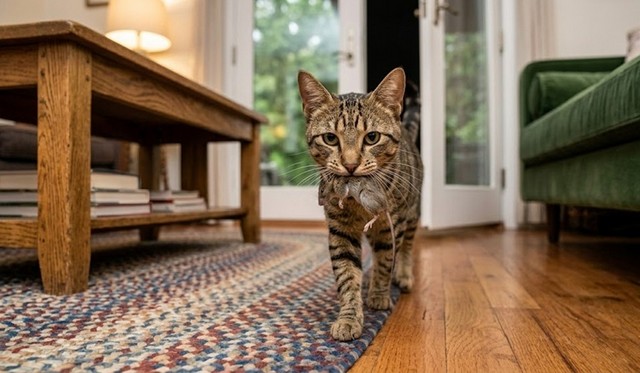
Your indoor cat does not hunt because it is hungry. It is simply fulfilling its instinctive biological needs. Kittens learn hunting from mothers who bring live or dead prey for “lessons,” and adults continue this cycle. When your cat drops a dead lizard at your feet, it’s not revenge; it’s an invitation to the family hunt, treating you as a fellow predator too clumsy to catch your own dinner.
In many cases, it can also be a teaching behaviour that a mother kittenshows by bringing dead animals to the kittens and to the owners.
7 Scientific Reasons Cats Bring You Dead Animals
Bringing you gifts has several connotations, all combined into one. It can be due to the blending of instinct, affection, and environment.
| Reason | Who Does It Most | Trigger |
|---|---|---|
| Teaching Hunt | Mother cats (76%) | Kittens/owners as “students.” |
| Sharing Spoils | All adults | Mealtimes, your return home |
| Affection Bond | Bonded cats | Trust/safety association |
| Boredom Relief | Indoor cats | Pest access, under-stimulation |
| Territory Mark | Unaltered males | Scent reinforcement |
| Incomplete Kill | All hunters | Practice without waste |
| Apartment Pests | Urban cats | Balconies/windows |
Teaching to hunt
By bringing home the dead animals, the mother is actually teaching its kittens how to hunt. Well-socialized adults extend this to owners, assuming you’re a helpless hunter needing lessons. A recent study has shown that in more than 76% of the cases, the cat that brings gifts is female.
Sharing the Spoils
The behaviour is also part of acting as the pack provider. Wild cats share kills with family during scarcity. Your cat views you as pack, proudly contributing. This peaks at mealtimes: “I brought dinner!”
✅Ignore completely (no reaction)
✅ Wear gloves, dispose of hygienically
✅ Redirect with toy/treat instantly
❌ Yell or punish (increases stress)
✅ Plan for other indoor cat enrichment for prevention
Affectionate Appreciation
The act of bringing you gifts can also stem from the bond the cat shares with you. It is your cat’s way of saying :”I trust you” or ” I care for you”. It can also be equivalent to grooming you.
Territorial, Practice & Apartment Factors
It can also be a sign of its territorial domination. It can be a sign of scent marking or incomplete predation. You may find that the behviour is more pronounced during monsoons.
Apartment-Specific Challenges: Why Gifts Happen Indoors
Urban cats hunt less but deliver dramatically. Limited territory forces indoor “processing.” of the actual gifts. Overfed cats hunt for fun. They may not eat what they have hunted. Instead, they want to showcase these hunts as trophies.
The behaviour differences between a house cat and an apartment can be quite distinct –
| Factor | Apartment Cats | House Cats |
|---|---|---|
| Gift Frequency | 2-3x higher | Outdoor disposal |
| Prey Type | 80% pests (lizards) | Birds/rodents |
| Delivery Spot | Bed/pillow (confined) | Doorstep |
| Prevention Ease | Netting + toys | Outdoor access |
Do you need to be Worried?
Under ideal conditions, bringing dead animals as gifts is quite normal. However, it is generally occasional. However, if you notice the behaviour is excessive, it may be time to consult your vet.
Check out the following symptoms –
| Warning Sign | Possible Cause | Action |
|---|---|---|
| Sudden surge | Stress/territory change | Vet check + Feliway |
| Uneaten gifts | Dental pain/illness | Oral exam |
| Live drops | Maternal overload | Spay consult |
| With peeing/aggression | Anxiety/MKD | Behaviorist; see cat peeing guide |
Conclusion
Cats bring dead animals because they see you as family who needs hunting lessons. However, there are a few ways you can minimise or prevent the behaviour.
You can either play with your cat daily or block access to the balcony. The best way is to ignore gifts. This has been observed to reduce incidents by 70-90%. In any case, bringing you gifts in the form of dead animals may be something that you may feel annoyed. But it is how your cat is expressing its love and trust for you.
Next time you find it doing this, simply ignore it, but do not yell at your cat or punish it.
FAQs
Will spaying my cat stop it from bringing dead animals?
No, spaying only reduces the behavior by about 20-30% at most. The hunting instinct is too deeply wired into your cat’s biology to be completely eliminated by neutering or spaying.
Is it safe to touch the dead animals my cat brings me?
Never touch them with your bare hands. These gifts can carry toxoplasmosis, a parasite that spreads through cat feces and prey, posing serious health risks, especially to pregnant women and people with weakened immune systems.
My cat suddenly started bringing more gifts—what should I do?
A sudden increase usually signals stress, territory changes, or health issues. New neighbors, construction noise, furniture rearrangement, or even a new family member can trigger more hunting as displacement behavior.



Add Comment