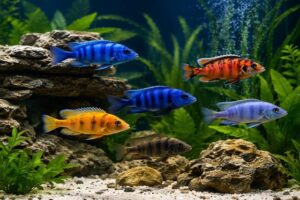
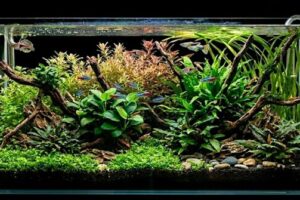
It is common to feel this way when you look at an aquarium in a mall or an office, or even at a friend’s home. “I wish I could do that at home!” Even when it may seem tough, it isn’t actually that difficult. However, you need a clear understanding of how to do it.
Keeping an aquarium is not an easy walk either. We at Dreamy Mammals understand, and that is exactly why we decided to share the complete details of fish keeping. From choosing your first tank to troubleshooting those pesky algae blooms, we’ll cover it all.
Beginner Aquarium Setup in 7 Steps
Why Start with a Freshwater Aquarium in 2026?
If you are a beginner, the freshwater aquarium is the best choice. Of course, saltwater setups would be an excellent choice and quite gorgeous. But keeping a saltwater aquarium is like jumping into a complex, advanced stage. Freshwater fish are hardy, affordable, and forgiving if you follow the basics.
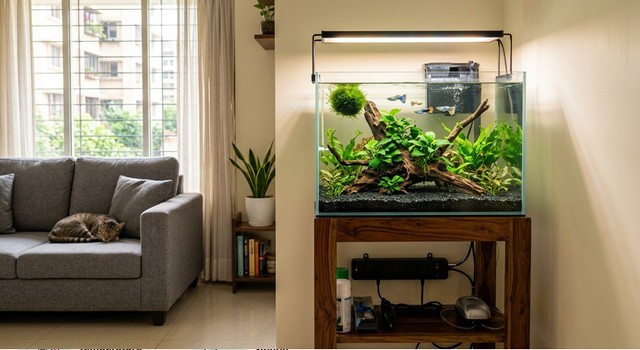
If you are living in an apartment, a small freshwater aquarium can be a good choice, offering an affordable, low-maintenance experience. An aquarium is not just about keeping fish in water. It’s a living system balancing fish waste, beneficial bacteria, plants, and light.
The good news is that modern gear like LED lights and quiet canister filters makes it easier than ever.
If you’ve wondered is it cruel to keep fish in tanks, the answer is no—when done right. Avoiding some unwanted habits should keep fish in a tank from being a huge concern. A spacious, filtered home mimics their natural habitat better than many wild rivers polluted by human waste. Your tank can be a sanctuary.
Ready to build one? Let’s talk gear.
Choosing the Perfect Tank Size and Location
The size of the tank matters much more than everything else. Begin with a size of 10-40 liters for beginners. A 20-liter nano tank fits apartments, holds 4-6 guppies, and costs under ₹2000. Go bigger (60-100 liters) if you have cats or dogs prowling—stability is key.
Location checklist:
- Away from direct sun: Algae explosion waiting to happen.
- Stable temperature: No AC vents, radiators, or kitchen heat.
- Low-traffic spot: Bedrooms or living room corners work best.
- Level surface: Wobbly tables will translate into leaks.
A good choice would be glass tanks with silicone seals. They would cost you around ₹1500-5000.
Essential Equipment: Don’t Skimp Here
A fit and working aquarium needs five pillars: tank, filter, heater, light, and substrate.
So, without ado, we will move to your shopping list.
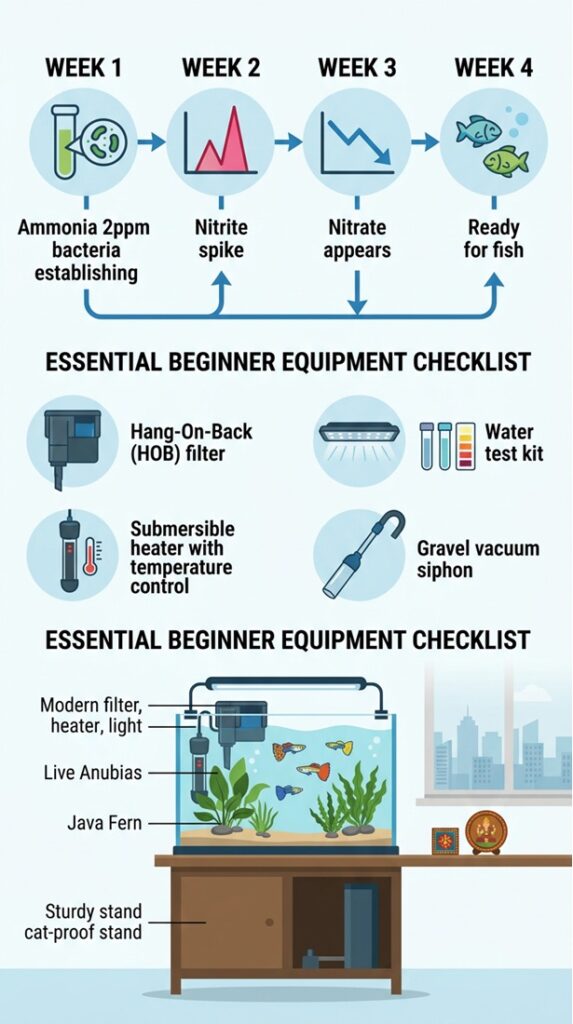
Filtration: The Heart of Your Tank
Fish waste and leftover food break down into ammonia. This can be quite toxic if left untreated. Filters house bacteria that convert it into far less harmful nitrates. For beginners, hang-on-back (HOB) or sponge filters are the way to go. Sponge filters are gentle for shrimp/bettas and cheap. You can buy them for under ₹300.
Ever debated whether you can turn off the aquarium filter at night? Short answer: no. Oxygen and bacteria require 24×7 flow. The filters should be run at all times. Of course, you may want to turn it off for about 15 to 20 minutes while feeding if it causes any turbulence. Quiet USB models are also an option for small tanks. Clean the filters monthly. Simply rinse the media in tank water (not tap water) to preserve bacteria.
Heater and Thermometer
Tropical fish like 24-28°C. JBL or Tetra submersible heaters with thermostats prevent dangerous temperature swings in a tank. If your region has temperatures reaching 35°C, you may need chillers.
You may need to turn off chillers and heaters based on the season. Heaters are turned off in summers and chillers are kept off in winters.
Lighting: Nature’s Glow Without the Burn
LED lights mimic day/night cycles. They should typically be turned on for 8-10 hours a day. For planted tanks, full-spectrum bulbs can be a good choice. Also, focus on easy-to-grow plants. Some easy plants include Java fern.
If you are wondering whether the fish need light to survive, note that they may need supplemental light if your apartment lacks natural light.
Substrate and Decor
Gravel or sand helps you anchor plants. They also host bacteria. You can use black gravel to hide fish poop.
You can add driftwood or caves to create hiding spaces. Rinse everything pre-setup to avoid cloudy startups. Gravel may need frequent, regular cleaning.
If you are unsure about how to clean the stones and gravel, read our advice on How to Clean Fish Tank Rocks? (Trusted Ways to Clean Fish Tank Stones)
Testing Kit and Maintenance Tools
Invest in a complete test kit measuring pH, ammonia, nitrite, nitrate, and temperature. It is also very important to keep nitrate levels minimal in a fish tank. Check our guide on how to lower nitrate in an aquarium for more information and guidance.
It is also essential to keep a gravel vacuum. Some other good options can include an algae scraper and spare filter media.
Weekly 25% water changes are another important factor to consider. This will maintain pristine conditions inside the tank when performed consistently.
Complete Step-by-Step Tank Setup Process – Follow Exactly
Establishing a healthy and thriving aquarium requires following a few key steps.
Week 1: Physical Setup and Equipment Testing
Weeks 2-4: Complete Biological Cycling Process
Monitor the biological process and take measurements at regular intervals. In fact, this will typically take around two to four weeks. A fishless cycle can be a good option for establishing a normal lifecycle in the tank.
Here is what you should do –
| Week | Ammonia | Nitrite | Nitrate | Action |
|---|---|---|---|---|
| 1 | 0.5-2 ppm | 0 | 0 | Add fish food daily |
| 2 | Drops to 0 | 0.5-2 ppm | 5-20 ppm | Patience! |
| 3-4 | 0 | 0 | 20+ ppm | Ready for fish! |
Choosing Your Perfect Starter Fish Community
Follow the rule – roughly 1 cm of adult fish per litre at the very most – and add fish gradually to build your community.
You can make a beginning with the following fish –
- Guppies: Colorful, prolific breeders, 3-5 cm adults
- Platies: Peaceful, various colors, excellent community fish
- Mollies: Sailfin varieties add drama, prefer hard water with a little salt
- Bettas require a minimum 20-liter tank with hiding spots. Do not use bowls. Check our article – Can betta fish live in bowls?
- Single large fish like Oscars need a very large tank. See Oscar tankmates
- Neon tetras (8 minimum): Blue/red fireworks
- White Cloud Mountain minnows: Cold water alternative
- Corydoras catfish (6 minimum): Peaceful bottom dwellers
Quarantine all new fish in a separate 10-liter container for 14 days. Feed high-quality flakes or pellets twice daily. Feed only what disappears in 2 minutes. It is advisable to fast completely one day per week.
Creating Your Dream Aquascape with Live Plants
Plants should be an exceptional option for converting your simple, functional aquarium into an artwork. They are also a practical option to improve the water quality in your fish tank.
Make a beginning with the simple plants –
- Anubias Nana: Tie to driftwood, grows in low light
- Java Fern: Multiple mounting options, slow but steady
- Vallisneria: Tall background grass, spreads naturally
- Marimo Moss Balls: Slow-growing, low-maintenance algae balls
Are you a busy individual looking for simple plants that require little maintenance? Read our article on Easy Low-Maintenance Aquarium Plants for Busy Owners
Add liquid fertilizer weekly (Seachem Flourish Comprehensive). Use plant ties or fishing line for attachment. This will help the roots to develop naturally.
Here are a few tips that can be helpful in improving the overall look –
Your Weekly Maintenance Schedule—Set and Forget
Taking care of your fish tank need not be a really difficult task. The trick we recommend is to follow a weekly schedule for each of the important tasks related to fish tank management.
Match the replacement water temperature closely (within about 1-2°C). Prepare the water in a bucket beforehand so it can reach the right temperature; there is no need to move your fish.
Use the dechlorinator every time you change or top up water. Consistent maintenance should prevent most problems.
Diagnosing and Solving Common Problems
Some common aquarium problems can be resolved with timely intervention. A keen eye for the changes should help you fix most of the issues.
| Problem | What to do |
|---|---|
| Cloudy Water | New tank bacteria bloom (wait 1 week) or overfeeding (fast 2 days, 50% water change). |
| String Algae | Reduce lighting to 6 hours, add Amano shrimp (3 per 40L). |
| Fish Gasping at Surface | Low oxygen—clean filter intake, add airstone. Also test ammonia and nitrite. |
| White Spots (Ich) | 30-minute salt baths (1 tablespoon per 10L), raise temperature to 28°C gradually. Use aquarium salt, and note that scaleless fish like corydoras are sensitive to salt, so check with an aquarium expert or vet first. |
| Fin Rot | Improve water quality immediately, medicate if advanced. |
Your Aquarium Journey Begins Today
Congratulations on reaching the end of this complete guide! You’ve now mastered tank selection, cycling science, fish compatibility, plant care, and troubleshooting.
Your thriving aquarium awaits – not just fish swimming gracefully, but genuine peace watching the balanced ecosystem you built from scientific understanding. Start small, observe daily, share your journey. The underwater world welcomes you home.
For complete information on fishkeeping and aquarium care, check out our entire fish/aquarium category. Every question you might have is capably answered.
✓A beginner freshwater tank needs five pillars: tank, filter, heater, light, and substrate.
✓Cycle the tank for two to four weeks before adding fish.
✓Keep the filter running 24×7, and test the water weekly.
✓Change about 25% of the water weekly, and always use a dechlorinator.
✓Start with hardy fish, and quarantine new fish for 14 days.
✓Avoid 5-litre fish bowls.
FAQs
How much time does maintenance take weekly?
It should not take more than 15 minutes. You can consider checking parameters every Monday, changing 25% of the water every Wednesday, wiping algae every Friday, and topping up the water every Sunday.
First fish died day 1 – what happened?
It can mean your tank is uncycled, which is often called new tank syndrome. An ammonia spike may also be a possible reason. Restart the fishless cycle and wait 21-28 days before restocking.
Brown algae everywhere – is this normal?
Yes. Brown algae (diatoms) are common in new tanks and usually fade as the tank matures. You can consider reducing the light exposure to 6 hours. It is also advisable to do a 30% water change every week.
How long does it take to cycle a new aquarium?
Cycling typically takes around two to four weeks. Add fish food daily during a fishless cycle. Your tank is ready for fish when ammonia and nitrite both read 0 and nitrate is present.
What size tank is best for a beginner?
Begin with 10-40 liters. Go bigger (60-100 liters) if you have cats or dogs prowling, because stability is key. Never use 5-litre fish bowls.
What is the best filter for a beginner aquarium?
Hang-on-back (HOB) or sponge filters are the way to go for beginners. Sponge filters are gentle for shrimp and bettas, and you can buy them for under ₹300.
How often should I change the water in my aquarium?
Change about 25% of the water every week, and use a dechlorinator every time you change or top up water.
What temperature should a tropical fish tank be?
Tropical fish like 24-28°C. Use a submersible heater with a thermostat, and you may need a chiller if your region reaches temperatures of 35°C.
Can I turn off my aquarium filter at night?
No. Oxygen and beneficial bacteria need 24×7 flow, so the filter should run at all times. You can switch it off for about 15 to 20 minutes while feeding if it causes turbulence.
How many fish can I put in my tank?
Follow the rule of roughly 1 cm of adult fish per litre at the very most, and add fish gradually. Quarantine all new fish in a separate 10-liter container for 14 days.
🐠 Was this helpful? Share it with a friend who wants to start an aquarium, or tell us in the comments about your first tank.
This article is for general information only. Aquarium conditions vary, so if your fish are sick, please consult an experienced aquarist or an aquatic vet.