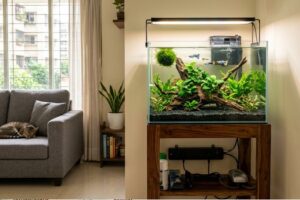
If you are a new aquarist, it can be confusing to decide whether the fish in your aquarium need light. Should the light stay on all the time, or be switched off at night? How long should it be on? In this guide, we look at whether fish need aquarium light, what light means for fish and plants, and how to set a schedule that keeps your fish healthy and your tank free of algae.
From my own aquarium: Based on my years of fishkeeping, I have found my fish becoming a bit unsteady when the bright light was left on for a continuous stretch. Since I started switching the light off at night, my fish have looked calmer, and the main problem I notice from too much light is algae.
Do the Fish in the Aquarium Need Light?
Aquarium lighting plays an important role in the health of fish and aquatic plants. Fish can survive without special artificial lighting, but a steady light-dark cycle matters for their body clock, behaviour and overall health. As Dr. Jessie Sanders, a board-certified fish veterinarian, explains, fish respond to the same circadian rhythms as most other life on earth, so the best lighting copies the natural cycle of light and dark.

Whether you need an aquarium light depends on what is in your tank:
- Fish-only tank: bright room light or indirect daylight can give the day-night signal. An aquarium light is optional and mainly helps you see and enjoy your fish.
- Planted tank: live plants need good light for photosynthesis, so you will need an aquarium light.
- Coral or reef tank: corals have specific light needs, so follow the coral’s requirements.
Most aquarium experts do not recommend very intense lighting, because very bright light can make fish hide. Moderate light can bring out your fish’s colours. Fish also see well: according to the same veterinarian, fish eyes are similar in structure to human eyes, with rod and cone cells, and some species see in low light while others are adapted to bright light. Species such as bettas and angelfish do well with steady, moderate lighting.
Can Fish Sleep With the Light On?
Fish can rest with the light on, but they rest better in the dark. Most aquarium fish are active by day and rest at night, so it is a good idea to switch off the tank light at night. A light that stays on around the clock can stress fish and disturb their rhythm.
Fish do not have eyelids, so they do not sleep the way mammals do. They enter a rest state with reduced activity and responsiveness. Research on zebrafish, a common aquarium fish, shows brain patterns similar to sleep in mammals, as reported in a Stanford Medicine study, and another peer-reviewed paper looked at sleep and wake patterns of adult zebrafish under extended light and extended dark. To learn more, read our guide on whether aquarium fish sleep.
This video shows how light can affect fish in an aquarium:
Do Aquarium Fish Need Sunlight?
No. Fish need light to see and to find food, but they do not need direct sunlight, and a normal room light is enough for most fish. Direct sun on a tank is a bad idea. As the fish vet notes, a sunny window can heat small volumes of water quickly and trigger algae blooms. That can turn the water green and harm your fish.

In my experience, fish also prefer natural room light as long as it does not hit the tank directly. A spot near a window, away from the sun’s rays, often works well.
How Many Hours of Light Do Fish Need a Day?
There is no single answer, and sources differ. Many aquarium guides suggest about 8 to 10 hours of light a day, while one fish veterinarian suggests starting indoor non-coral tanks with 12 to 16 hours of light and 12 to 8 hours of dark. A practical approach is to begin with around 8 to 10 hours, then watch your tank, especially for algae, and adjust. Retailer Warehouse Aquatics also advises against leaving lights on for very long periods, since fish need a dark period to rest.
| Tank Type | Typical Light Period | Notes |
|---|---|---|
| New tank | About 8 to 10 hours | Start low to limit algae, then raise by an hour at a time if the tank stays clear |
| Fish only, no live plants | About 8 to 10 hours, up to around 12 | Room light can do much of the work; keep the schedule steady |
| Planted tank | Start around 8 hours, increase slowly | Some plants want more light; I suggest stopping at about 12 hours at most and watching for algae after each change |
| Tropical fish | About 8 to 12 hours | Begin near 10 hours and adjust by algae growth and fish behaviour |
| Saltwater fish and reef | About 8 to 10 hours | Coral tanks should follow the corals’ natural light needs |

Excessive light can disturb the fish
How to Set Up a Good Light Schedule
✅ Use a simple timer or smart plug so the light always comes on and off at the same times
✅ Start with 8 to 10 hours and change by one hour at a time, watching for algae after each change
✅ Choose a light with a dimming or “sunrise and sunset” feature if you can; the vet notes that a slow increase in light is better than a sudden switch
✅ Keep the tank out of direct sunlight
✅ Adjust seasonally if you rely on natural light from a window
Recommended reading: 6 Shocking Reasons Your Betta Fish Disappeared from Tank!
Should I Turn My Aquarium Lights Off at Night?
Yes, in most cases. Fish do not need light at night, and a dark period lets them rest. Leaving the light on all night can disturb their body clock and cause algae to grow. Many aquarium guides, such as Aquariadise, point out that fish only need a signal for day and night, and ambient room light is often enough.
If you can, avoid an abrupt switch-off. Gradual dimming is gentler and avoids startling fish. Some species like to “sleep in” and stay hidden until their eyes adjust to the light. Be careful with blue or purple “night” lights, which the vet notes can make some fish and decor glow and are not a replacement for real darkness. Also note that turning off the light is different from turning off the filter; see our guide on turning off an aquarium filter at night.
What Kind of Lighting Do Fish Need?
LED lights are now the standard for most aquariums, as the fish vet notes. They are energy efficient, run cooler than older bulbs, last a long time and come in many spectrums. Choose a light made for aquariums, rather than a household bulb, and make sure it fits your tank and what you keep in it.

| Light Type | Pros | Cons | Best For |
|---|---|---|---|
| LED | Efficient, long-lasting, runs cooler, many colour and timer options | Quality varies; too bright or too long can still cause algae | Most tanks |
| Full spectrum | Closer to daylight, supports plants | Can cost more | Planted tanks |
| Actinic (blue) | Pleasant look, brings out colours, used with corals | Mainly decorative in fish tanks; not a replacement for darkness at night | Reef and display tanks (as an extra) |
| Fluorescent | Widely available, many shades and sizes, used in fresh and saltwater tanks | Tubes fade and need replacing | Older hoods and budget setups |
| Incandescent / halogen | Cheap | Produces a lot of heat and has a short life, which can upset a small tank | Generally not recommended |
What Is the Best Colour Temperature for Aquarium Fish?
Colour temperature is measured in Kelvin (K). For a fish-only freshwater tank, light in the range of about 5,500 to 6,500 K is a good choice, since it is close to natural daylight. Planted tanks are often run at about 6,000 to 7,000 K, but this varies by plant and light. Colour temperature describes the colour of light, not how strong it is.
| Plant Light Requirement | Example Plants | Rough PAR Range |
|---|---|---|
| Low light | Anubias, Java fern | About 15 to 30 |
| Medium light | Cryptocoryne, Amazon sword | About 30 to 50 |
| High light | Monte Carlo, dwarf hairgrass (carpeting plants) | 50 and above |
These ranges are a rough guide. Growers and light manufacturers differ, so check what your plants and light recommend.
The Planted Tank Balance: Light, CO2 and Nutrients
For a healthy planted tank, light is only one piece of the puzzle. Plants need light, carbon dioxide (CO2) and nutrients, and an imbalance in one can lead to algae outbreaks:
- Light gives the energy for photosynthesis.
- CO2 is the carbon source for growth. Without enough, extra light is wasted and algae can take advantage. Many low-tech tanks do well without added CO2 by using low-light plants.
- Nutrients, such as nitrogen, phosphorus, potassium and trace elements like iron, are the building blocks. If they run short, plants cannot use the light and CO2 well.
Think of it as a three-legged stool: if one leg is too short, the whole system becomes unstable and favours algae. Keeping nitrates in check also helps, so read our guide on how to lower nitrates in your aquarium.
Too Much Light vs Too Little Light
Both extremes can cause problems for fish. Light that is too bright or left on too long encourages algae, can warm the water and may disturb your fish’s sleep. Light that is too dim or missing can make fish sluggish and stop plants growing.
| Too Much Light | Too Little Light |
|---|---|
| Green water or algae on glass and plants | Sluggish, less responsive fish |
| Fish hiding, nervous or unsteady | Faded colours |
| Disturbed sleep and loss of appetite | Stress and behaviour changes from a confused day-night rhythm |
| Warmer water, especially with sun or hot bulbs | Weak or dying live plants |
Watch out for algae. The commonest result of too much light I see is algae growth. Heavy algae can lower oxygen in the water, especially at night, and swing the pH, which hurts water quality. If algae appear, shorten the light period by an hour or two, move the tank away from sunlight and check your nitrates and phosphates.
Fish can survive short spells of darkness, for example during a power cut. But long-term darkness removes the day-night signal and can cause stress. If the tank has live plants, they will begin to die without light. A steady cycle helps fish regulate sleep and behaviour, which is why it pays to match the day and night they would have in nature.
Do Fish Need Light to Eat?
Most aquarium fish find their food by sight, so feed them when there is enough light for them to see it. Feeding in total darkness makes it harder for many species to find food. Some nocturnal species, such as many catfish, find food in the dark using smell and touch. Turn the tank light on at feeding time, or make sure there is good room light, and then follow your normal schedule.
Dreamy Mammals Pro Tips
Turning lights off
A consistent light schedule matters most. Sudden, large changes in light hours, or forgetting to switch the light off, can stress fish, and signs include clamped fins and erratic swimming. Gradual dimming or a timer makes a big difference.
Excess light and algae
A common mistake when beginners fight algae is to extend the dark period indefinitely. Shortening the light helps, but algae control lasts longer when you also fix nutrient imbalances, such as excess nitrates and phosphates, and balance light, nutrients and CO2 in planted tanks.
Frequently Asked Questions
Can fish survive without light in the aquarium?
Are LED lights bad for fish?
Does the aquarium need light at night?
Do fish need light to eat?
Do betta fish need light at night?
Do tropical fish need light in the aquarium?
Do fish need darkness to sleep?
The Closing Thoughts
Even though fish do not strictly need an aquarium light, a steady light and dark cycle is one of the best things you can give them. Choose LED lighting, use a timer, keep the tank out of direct sun, and watch your tank for algae, adjusting the hours as needed. Your fish, and your plants, will thank you.
Key Takeaways
- Fish need a regular day-night cycle more than a special aquarium light. Room light can be enough for a fish-only tank.
- Live plants need aquarium lighting, and they are the main reason most tanks use it.
- Switch the light off at night, use a timer, and start with about 8 to 10 hours of light, adjusting for algae.
- Avoid direct sunlight. It heats small tanks and triggers algae blooms.
- Choose a quality LED made for aquariums, and keep the colour temperature around 5,500 to 6,500 K for fish-only tanks.
Did you find this helpful?
How many hours do you keep your aquarium light on? Tell us in the comments, and share this post with another fish keeper.
You may also want to read: